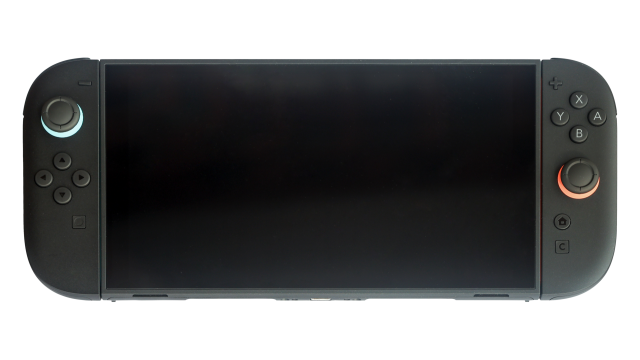
Nintendo Switch 2
Manufacturer: Nintendo
Launches: 2025
Generation: 9th
Country releases of Nintendo Switch 2
 Europe: Europe: | 05/Jun/2025 | 470 | € |
 USA: USA: | 05/Jun/2025 | 450 | $ |
 Australia: Australia: | 05/Jun/2025 | 699 | $ |
 Canada: Canada: | 05/Jun/2025 | 630 | $ |
 United Kingdom: United Kingdom: | 05/Jun/2025 | 396 | £ |
 Japan: Japan: | 05/Jun/2025 | 50 | ¥ |
 Nintendo Switch 2 technical specifications
CPU: Octa-core ARM Cortex-A78C
Memory: 12 GB
 Nintendo Switch 2 video specifications
Nintendo Switch 2 graphics capabilities.
 Nintendo Switch 2 audio specifications
Nintendo Switch 2 sound capabilities.
Audio chip:
Audio mode: 5.1
 Controllers of Nintendo Switch 2
The Nintendo Switch 2 revolutionizes player input by completely introducing a redesigned suite of control accessories.
Both the modular Joy-Con 2 and the high-end Nintendo Switch 2 Pro Controller have been engineered from scratch to resolve past hardware limitations while embedding entirely new physical, functional, and communication capabilities directly into the physical hardware layout.

The electromagnetic Joy-Con 2 and mouse mode functionality
The primary modular controllers discard the older mechanical slider rails that defined the previous hardware generation. Instead, the system introduces a highly durable magnetic coupling system powered by heavy-duty internal electromagnets that snap tightly against the main chassis of the screen. To separate the controllers safely from the tablet, users must press a dedicated physical release toggle located on the back of each unit, ensuring that the controllers never slide off accidentally during intense portable play sessions.
Beyond this structural shift, the controllers pioneer a brand-new mechanical flexibility known as Mouse Mode. Both individual Joy-Con 2 pieces are built with specialized flat bottom sensors that allow them to be placed flat and glided across a table or desk interface just like a traditional PC mouse. This feature provides swift, precise cursor control across the integrated operating system menus, the digital storefront, and specific strategy or simulation games that benefit from localized point-and-click accuracy.
The Switch 2 Pro controller and advanced communication
For standard living room configurations, the premium gamepad receives a massive feature overhaul designed to support competitive multiplayer environments. The device integrates a dedicated C Button engineered specifically for immediate integration with the native GameChat online platform, giving players a one-touch hardware option to join voice lobbies. Additionally, the underside of the outer shell now sports two customizable paddles labeled GL and GR, which allow players to remap complex action combinations without lifting their thumbs off the primary analog sticks.
Audio accessibility is also upgraded through a dedicated 3.5mm headphone jack built directly into the bottom edge of the controller shell, giving players a direct line for wired audio headsets without needing long cables reaching all the way to the TV dock. The main power source retains an exceptional 40-hour battery life cycle over a standard USB-C connection while powering internal motion gyroscopes, an advanced HD Rumble 2 tactile feedback motor array, and a built-in Near Field Communication reader for reading amiibo figurines.
Backward compatibility of switch 2
Nintendo maintains strong ecosystem continuity by allowing extensive wireless backward compatibility across its controller lineup. Players can easily sync their original, first-generation wireless Joy-Cons and classic Pro Controllers directly to the new console software to enjoy multiplayer games immediately out of the box. However, due to the radical physical shift from mechanical slider tracks over to the new electromagnetic lock plates, original first-generation Joy-Cons cannot physically slide onto or attach to the sides of the new handheld console screen.
 Nintendo Switch 2 games support
Support: Card
The Nintendo Switch 2 revolutionizes how players interact with physical software and expandable storage, fundamentally shifting its infrastructure to meet next-generation speed demands. Nintendo introduces a multi-tier physical media framework composed of standard high-speed Game Cards alongside an entirely new download-facilitating media type known as Game-Key Cards. By separating software storage into specialized physical structures, the console satisfies the immense storage requirements of modern AAA titles while honoring the physical historical libraries of its consumer base.
The Dual Game Card Format and Next-Gen Data Speeds
The primary game card slot has been meticulously redesigned to handle a split media format while keeping the structural dimensions uniform with past hardware. Standard dedicated software now ships on vibrant red physical Game Cards, contrasting sharply with the gray cartridges of the older generation to clearly signal upgraded internal architectures. These new red cartridges feature dramatically accelerated data reading speeds to pull heavy visual assets onto the console screen seamlessly. To maintain physical safety across generations, a slight hardware design modification prevents these high-performance red cartridges from being forced down into original, older Nintendo Switch devices.
Simultaneously, the platform introduces the innovative Nintendo Switch 2 Game-Key Card system to accommodate ultra-massive open-world files without driving up physical production costs. Unlike a traditional cartridge that holds complete gameplay data locally, a Game-Key Card acts as an encrypted physical ownership token. Inserting a Game-Key Card for the first time triggers a mandatory background download of the full software directly from the digital ecosystem to local memory storage. Once the initial automated data transfer completes, the internet connection requirement drops completely, meaning players only need to insert the physical key card into the slot to verify ownership and play completely offline.
Physical Backward Compatibility and Verification Layers
Nintendo safeguards past software investments through hardware-level backward compatibility for legacy physical cartridges. The redesigned console media slot natively accepts the standard gray physical cartridges from the original generation, providing immediate access to an overwhelming majority of the existing software catalog. When an original cartridge drops into the upgraded reader slot, the internal software pipeline interprets the legacy code through an automated translation layer, instantly maximizing the rendering performance of older titles.
While the overall system compatibility rate is incredibly high, certain physical software packages present minor functional variances due to missing hardware elements on the newer console shell. Because some legacy games relied on older mechanical configurations or distinct structural features, player behavior or execution might vary. To ensure complete clarity before handling physical software transfers, users can access the official online Nintendo Software Compatibility database to verify individual title ratings, which flag software as fully supported, conditionally supported with minor variances, or completely unsupported.
Mandatory MicroSD Express Storage Evolution
To support the massive file downloads demanded by both digital software and the new Game-Key Card system, Nintendo completely overhauled its external memory architecture. The platform drops compatibility with traditional legacy memory expansion units, making the console exclusively compatible with microSD Express cards. This technological leap utilizes advanced PCI Express and NVMe protocols to provide data transfer capabilities that match modern desktop computing storage networks, which is absolutely vital for eliminating performance stuttering during real-time asset streaming.
Because the operating system requires this extreme performance ceiling, legacy memory cards utilized in first-generation hardware cannot be used to store or boot software on the new platform. However, the system includes a dedicated internal migration utility designed to protect user-generated creative content. Players can safely insert an older memory card to execute a one-way transfer, copying saved screenshots, capture footage, and media albums over into the main console storage, ensuring that personal gameplay memories migrate smoothly into the modern era.
Nintendo Switch 2 games
Games library:
Nintendo Switch 2 story
The Nintendo Switch 2 represents a massive technological milestone in the gaming landscape, launching globally on June 5, 2025. This next-generation console preserves the beloved hybrid form factor of its predecessor while completely overhauling the underlying infrastructure to satisfy modern computational and gaming expectations. By blending substantial graphical architecture improvements with brand-new physical connectivity interfaces, Nintendo delivers a highly versatile ecosystem engineered to excel in both portable scenarios and home theater configurations alike.
The hardware transition bridges the stark generation gap that previously isolated handheld players from experiencing demanding modern interactive media. Developers no longer face severe performance constraints when scaling software down for on-the-go play, which fundamentally reshapes how publishers approach multi-platform game deployment. Consequently, the ecosystem establishes an optimized standard for unified gaming experiences, providing a durable platform that addresses past hardware bottlenecks while pioneering accessible, cutting-edge hardware design.
The most immediate physical improvement is the expansive 7.9-inch handheld display built directly into the main chassis. Portable gaming experiences reach peak visual clarity because the screen outputs a native 1080p resolution, eliminating the pixelated artifacts and blurry text scaling that often plagued the older hardware. Individual sub-pixels provide incredibly sharp rendering, creating deep contrast ratios and pristine detail retention even when players view complex, fast-moving geometry during outdoor handheld play sessions.
When the console slides into its newly redesigned home dock, it shifts into an entirely different performance tier. The system leverages an optimized silicon layout to output a clean 4K ultra-high-definition resolution directly to compatible living room television sets. This massive pixel bump is further enhanced by full High Dynamic Range (HDR) color space integration, which vastly expands the luminosity spectrum to produce incredibly bright highlights alongside deep, accurate shadow tones. Furthermore, the upgraded panel and internal pipeline support a fluid 120 frames per second refresh rate, ensuring exceptionally low input latency and highly responsive motion clarity during competitive gameplay.
Deep inside the custom silicon layout, the underlying processing architecture has undergone a radical transformation designed to handle heavy multi-threaded workloads. Storage limitations that previously forced users to purchase external accessories are largely resolved out of the box because the base model introduces 256 GB of high-speed internal flash storage. This modern non-volatile memory solution drastically accelerates read and write speeds across the system bus, allowing asset streaming pipelines to pull environment files almost instantaneously. Because data transfers occur so rapidly, developers can easily eliminate artificial loading screens, hidden elevators, and long loading corridors within expansive open-world map layouts.
This immense power boost does not abandon the extensive history established by the previous platform generation. The architecture features hardware-level backward compatibility, allowing legacy collections to transition smoothly into the new ecosystem without friction. Users can insert their original physical game cartridges or redownload digital software catalogs to instantly experience their favorite adventures with massive automatic performance enhancements. Legacy software automatically benefits from more stable frame rates, maximum dynamic resolution scaling targets, and significantly reduced loading times without requiring mandatory software patches from the original developers.
Redesigned Magnetic Joy-Con Control Interfaces
The core interface between human and machine has been entirely reimagined through a revolutionary magnetic coupling system built for the brand-new Joy-Con controllers. Nintendo completely eliminated the traditional mechanical sliding rails of the older hardware generation, which were prone to structural wear and physical warping over long periods of continuous deployment. Instead, high-strength specialized electromagnets guide the controllers into a perfectly aligned orientation, locking the physical units against the main chassis with remarkable structural rigidity that forms an incredibly secure, solid hold.
Beyond this advanced attachment mechanism, the physical form factor of the controllers features refined ergonomic contours designed to drastically reduce hand fatigue during extended gameplay sessions. The rear plastic moulding settles naturally into the palms of the hands, distributing the total physical weight evenly across the fingers. Additionally, internal analog potentiometer elements have been engineered from the ground up to completely eradicate analog stick drift, ensuring perfect directional accuracy for the lifespan of the device. These sticks pair perfectly with brand-new, highly sensitive analog triggers that accurately register variable depth inputs, offering precise acceleration and braking controls for advanced simulation software.
Previous Nintendo console: Nintendo Switch